

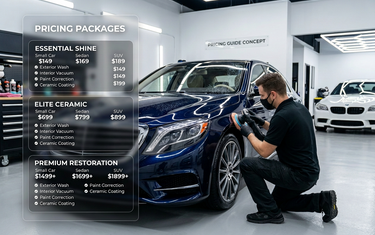
Pricing is where a lot of good detailers struggle. Charge too little and you work long days for almost nothing. Guess too high without a reason and customers walk. The fix isn't copying the shop down the street. It's knowing exactly what each job costs you, then building packages that cover those costs and pay you properly.
Here's how we help detailers think through pricing at Vital Detail Supplies, from the basic formula to packages, upcharges and add-ons.
The basic pricing formula
Every job price should cover four things:
- Labor: the hours the job takes, multiplied by the hourly rate you want to earn.
- Product cost: the chemicals, pads, towels and coating that get used up on that car.
- Overhead: a share of everything it costs to run the business, like insurance, fuel, phone, software, equipment wear and marketing.
- Profit: money the business keeps on top of your wage, for growth, new equipment and slow months.
Step 1: Know your hourly rate
Start with what you need to earn, not what competitors charge. Decide on a yearly income goal, then divide by the hours you can realistically bill. Remember that not every working hour is billable: driving, quoting, cleaning towels, restocking and answering messages all take time. Many solo detailers find they can only bill a portion of the hours they actually work, so set your rate with that in mind.
Pro tip: Time yourself on every job for a month. Most new detailers underestimate how long a full interior or a polish really takes, and that's where underpricing starts.
Step 2: Work out your product cost per job
Product cost is usually smaller than labor, but it adds up, and it's the easiest number to lower. The biggest lever is buying the products you use most in larger sizes. For example, ADS Hero Rinseless Wash is $17.99 for 16 oz or $64.99 for a gallon. That's about $1.12 per ounce in the small bottle versus about $0.51 per ounce in the gallon, less than half the cost for the same product.
To find your cost per job, note how much of each product a typical car uses and multiply by the cost per ounce. Don't forget the items that wear out over many jobs:
- Towels. Plush towels like the Autofiber Korean Plush 350 last many washes, but they don't last forever. Divide the price by roughly how many jobs you get from a pack.
- Pads. Polishing pads such as the Rupes DA Fine Polishing Foam Pad wear out after a number of cars, so spread their cost across correction jobs.
- Coatings. For ceramic jobs, include the coating itself, like ADS Quartz Coating or ADS PRO Quartz Coating, plus your prep spray such as P&S Paint Coating Surface Prep and the applicators.
Step 3: Add your overhead
Add up a month of business costs that aren't tied to one car: insurance, fuel, vehicle payments, phone, booking software, website, marketing, equipment repairs and replacements. Divide that by the number of jobs you do in a month. That number gets added to every job, whether it's a quick wash or a full correction.
Equipment is part of this. A polisher like the Rupes LHR15 Mark V or an extractor like the Mytee S-300H Heated Carpet Extractor pays for itself over many jobs, so build a small share of its cost into your prices so you're ready when it's time to replace it. Our mobile detailing supply checklist covers what most businesses need to budget for.
Step 4: Build packages, not one-off quotes
Packages make booking easier for customers and quoting faster for you. Most detailers do well with a short menu that goes from quick to premium. Here's a common structure:
| Package | Typically includes | What drives the price |
|---|---|---|
| Maintenance wash | Safe exterior wash, wheels and tires, dry, quick interior vacuum and wipe-down | Mostly labor; low product cost. Great for recurring clients. |
| Interior detail | Full vacuum, plastics and vinyl cleaned and protected, glass, carpets and mats shampooed or extracted | Condition matters most: pet hair, stains and sand add a lot of time. |
| Full detail | Interior detail plus exterior wash, decontamination, sealant and tire dressing | Labor on both halves of the car plus decon and protection products. |
| Paint enhancement (one-step polish) | Wash, decon, clay, one polishing step, protection | Machine hours, pads and polish. Price by vehicle size. |
| Paint correction (two-step or more) | Compound and polish to remove heavier defects, then protection | Many hours of skilled work; quote after inspecting the paint. |
| Ceramic coating | Full prep and polish, panel wipe, coating application, cure time | Prep and polish labor, coating cost, and the durability you're offering. |
Name your packages clearly and list exactly what's included so customers can compare at a glance. Three to five options is plenty.
Step 5: Set upcharges and add-ons
Two cars booked for the same package can take very different amounts of time. Upcharges keep you from losing money on the hard ones:
- Vehicle size. Price by small car, midsize SUV and large truck or van, since bigger vehicles take longer and use more product.
- Condition. Heavy pet hair, sand, mold, stains, smoke odor or severe contamination should carry an extra charge. Say this up front so there are no surprises.
- Travel. Mobile detailers often charge extra beyond a set service radius.
- Water and power. If you bring your own water tank and power, factor in that setup.
Add-ons let customers customize, and they boost your average ticket. Popular ones include engine bay cleaning, headlight restoration, glass coating, wheel coating like ADS Wheel Coating, trim restoration with ADS Trim+ Coating, odor treatment and extra carpet extraction.
A worked example
Here's how the formula comes together. These numbers are only an example; use your own time, costs and local market.
- A midsize SUV full detail takes you 4 hours, and your target rate is $50 per hour: $200 labor.
- Products used come to about $15.
- Your overhead works out to $20 per job.
- You add 15% profit on top of that $235: about $35.
That puts this job at roughly $270. If that's far below what established detailers near you charge, you may be underpricing your work. If it's far above, look for ways to work faster or lower your costs, or make sure your package clearly delivers more.
Check it against your market
Once you know your real costs, look at what other detailers in your area charge and what they include. You don't have to be the cheapest. Customers will pay more for clear packages, good photos of your work, reliability and reviews. If your cost-based price sits well below the market, you have room to raise it.
Detailing pricing checklist
- Set your hourly rate from your income goal and realistic billable hours.
- Time every job type so your hour estimates are real.
- Calculate product cost per job, and buy gallons of the products you use most.
- Spread overhead and equipment replacement across every job.
- Add a profit margin on top of your wage.
- Build three to five clearly named packages.
- Set upcharges for size, condition and travel, and state them up front.
- Offer add-ons to raise your average ticket.
- Compare with local competitors and review your prices regularly.
Want help lowering your cost per job or choosing the right gallon sizes for your business? Stop by our store at 9121 Garvey Ave in Rosemead or call us at (626) 656-6226 and we'll help you build a product lineup that fits your packages. Happy detailing!
